
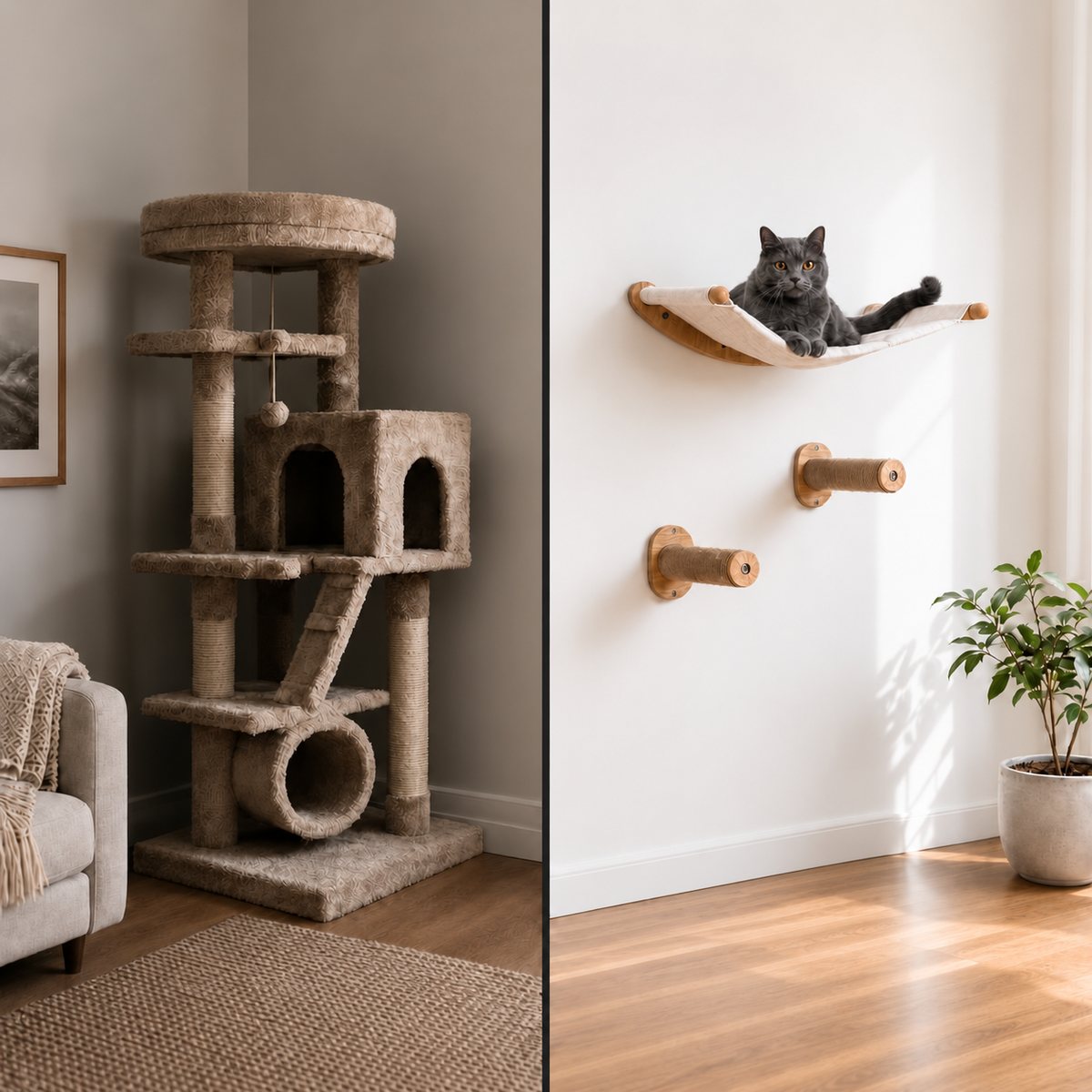
One’s human frets that the home is too small for a cat of one’s stature. Nonsense, kitten. A small kingdom is still a kingdom — one simply rules it more efficiently. The trick is not less territory, but cleverer territory. Allow one to explain how a cat may be thoroughly spoiled without burying the poor human’s floor beneath a mountain of beige. — Ruby
Small spaces need smarter enrichment, not less
Here’s the mistake people make in a small home: they assume the answer is to give the cat fewer things. In fact, cats in small spaces often need enrichment more, not less — a smaller home means fewer natural opportunities to climb, explore and retreat. The goal isn’t to cut back on enrichment; it’s to deliver it without eating up the limited floor you have.
Done well, a small-space setup gives your cat everything it needs — height, a scratching outlet, a private retreat, a sunny lookout — while keeping your rooms feeling open. It’s entirely possible. It just takes a slightly different approach than filling a big house.
Go vertical — the single best move for small spaces
If you take one thing from this guide, take this: in a small home, build upward, not outward. Cats naturally want height, and wall space is space you’re almost certainly not using. Wall-mounted furniture turns a bare wall into climbing, perching and lounging territory without costing you a single square foot of floor.
A HALTO wall hammock gives a sunlit perch on a slim footprint; ALTO adds two steps to create a compact climbing route; and SALTO steps let you extend the route as high as your ceiling allows. This is enrichment measured in wall height, not floor area — exactly what a small home needs.
Choose floor-free and dual-purpose pieces
Where something must sit at floor level, make it earn its place. A few principles for small spaces:
Favour wall-mounted over free-standing. A wall scratcher like LISSE takes essentially zero floor space, unlike a bulky post — and it can even be laid flat on the floor if you’d rather not drill.
Look for pieces that do two jobs. Steps that double as scratching surfaces, or a hammock that’s both a bed and a perch, pack more enrichment into less stuff.
Go slim. Low-profile pieces that sit close to the wall read as part of the room rather than obstacles in it.
What to skip in a small space
Just as important is what to leave out. In a small home, a giant carpeted cat tree is usually the wrong call — it dominates the floor, blocks light and sightlines, and rarely looks good. So do piles of single-purpose plastic toys and gadgets that clutter without adding much. The small-space rule is simple: fewer, better, wall-mounted things beat a crowd of bulky floor pieces every time.
Placement — enrich without overcrowding
In a small room, where you put things matters as much as what you buy. Keep the floor as clear as possible and push enrichment up onto the walls. Group a perch, a step or two and a scratcher on a single wall — ideally by a window — so the enrichment is concentrated in one considered zone rather than scattered around the room. Leave clear sightlines and walking paths; a room that still feels open to you will feel calmer for your cat too. And keep resources like food, water and the litter tray sensibly separated, even in a small footprint.
A small-space enrichment checklist
For a small home that works for both of you: give your cat at least one elevated perch; add a compact climbing route up a wall; provide a wall-mounted or floor-flat scratcher; include one quiet retreat; keep the floor as clear as you can; and choose slim, neutral, dual-purpose pieces over bulky single-use ones. Tick those and your cat is fully enriched without an inch of your home feeling crowded. Build a coordinated set from the full collection.
And so the myth is dispelled, kitten: a small home is no barrier to a properly spoiled cat. Send one’s kingdom up the walls, keep the floor clear for one’s human to shuffle about on, and everyone is content. One does so admire an elegant solution — almost as much as one admires oneself surveying it all from the highest perch in the room. — Ruby
Frequently asked questions
Can you have cat furniture in a small apartment?
Yes. The key is going vertical: wall-mounted hammocks, steps and scratchers add climbing and resting space without using floor area, so even a small apartment can be richly enriching for a cat while staying open and uncluttered.
What is the best cat furniture for small spaces?
Wall-mounted, slim, dual-purpose pieces are best — a wall hammock for perching, wall steps for climbing, and a wall or floor-flat scratcher. They deliver enrichment on the walls instead of the floor, which is exactly what small homes need.
How do I enrich my cat without cluttering my home?
Build upward rather than outward, choose neutral pieces that blend with your decor, group enrichment on a single wall, and favour fewer, better, multi-purpose items over piles of plastic toys. Keeping the floor clear keeps the room feeling open.
Are cat trees a good idea in a small space?
Usually not. Large carpeted cat trees dominate the floor, block light and sightlines, and rarely suit a small room. Wall-mounted furniture gives the same height benefits in a far smaller footprint.
Do cats in small homes still need enrichment?
Yes — arguably more. A smaller home offers fewer natural chances to climb, explore and retreat, so deliberate enrichment matters even more. It just needs to be delivered vertically to avoid overcrowding.


Leave a comment
This site is protected by hCaptcha and the hCaptcha Privacy Policy and Terms of Service apply.