
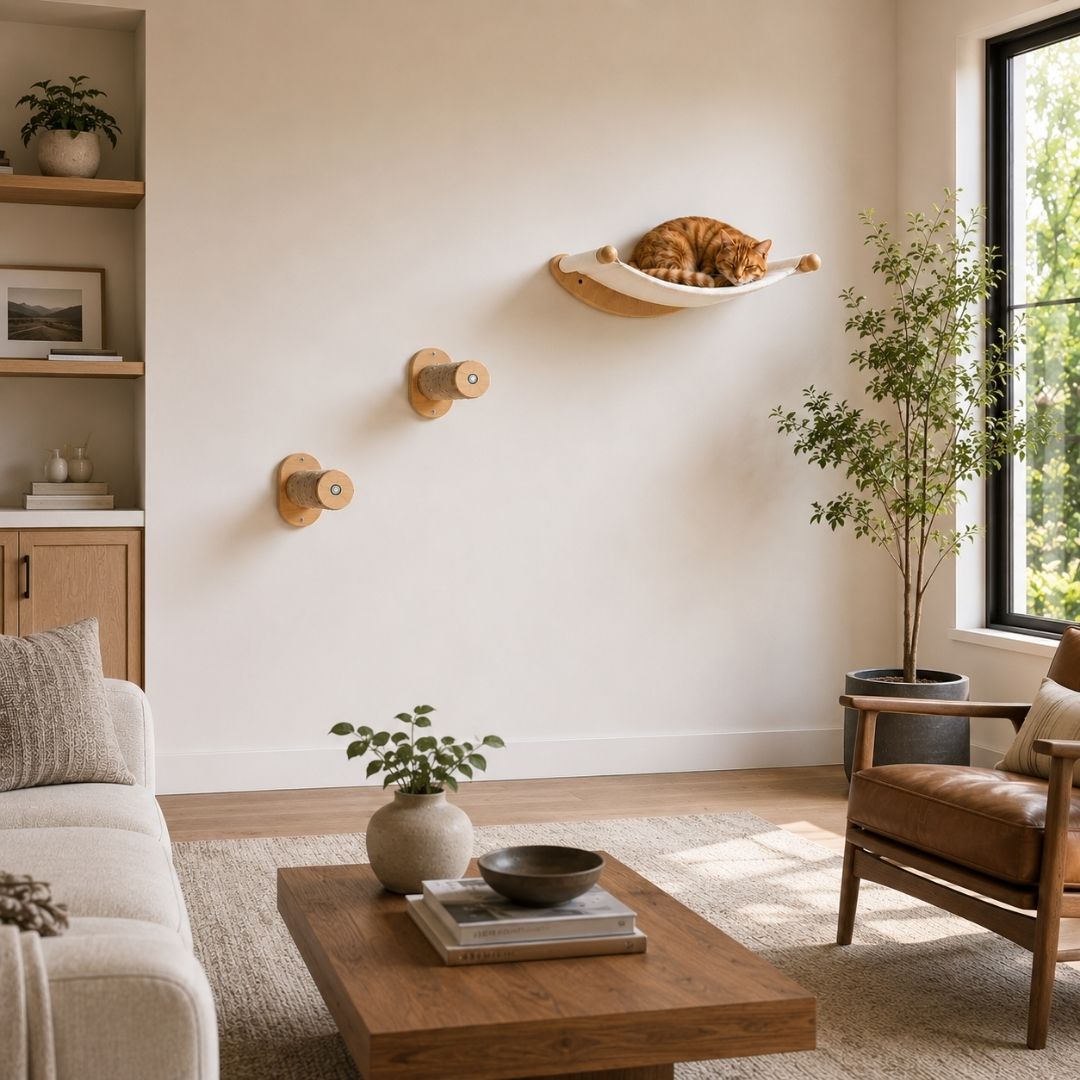
“One has, on occasion, overheard one’s human debating where precisely to allocate wall space on one’s behalf. The discussion, it must be said, has not always been as informed as one would hope. Cat hammock or cat shelf? They mutter this as though the distinction were trivial. One assures you: it is not.”
— Ruby
If you are trying to decide between a wall mounted cat hammock and a cat wall shelf, this guide will walk you through the real differences — in design, function, comfort, and what your particular cat is most likely to actually use. Because the wrong choice sits empty on your wall and makes absolutely no one happy. The right one becomes your cat’s entire personality.
What Is a Cat Wall Shelf?
A cat wall shelf is exactly what it sounds like: a flat, rigid surface mounted to the wall at height. Think of it as a small ledge — purpose-built for a cat, usually in wood or MDF, sometimes with carpet or a sisal surface, occasionally with a lip around the edge to stop a sleeping cat from rolling off.
Cat shelves are the original wall mounted cat furniture. They are simple, modular, and easy to combine into “cat highways” — a series of steps and platforms running up or across a wall that allow a cat to traverse a room at height. They work beautifully in multi-cat households where different cats need different levels, and they are excellent for highly active, younger cats who want to leap and move rather than simply nap.
The limitation of a standard cat wall shelf is comfort. A flat shelf — even a padded one — does not contour to a cat’s body the way a hammock does. For long, deep napping sessions (and indoor cats sleep between 12 and 16 hours a day), a rigid surface is simply not as restorative.
What Is a Wall Mounted Cat Hammock?
A wall mounted cat hammock is a suspended sleeping platform — typically a fabric or cushioned base held within a frame, fixed to the wall at height. The defining feature is give: when a cat steps onto a hammock, the surface yields slightly beneath them, cradling their body in a way that a rigid shelf cannot.
This matters more than it might seem. Cats in the wild choose sleeping spots that feel enclosed and supported — hollows in trees, tucked spaces, spots where their bodies are held rather than exposed. A hammock mimics this instinct beautifully, which is why cats who discover a quality hammock tend to become extraordinarily devoted to it.
A well-designed cat wall hammock is also a statement piece. Where a basic shelf can look functional and utilitarian, a hammock — with its frame, cushion, and proportions — has the presence of a designed object. It earns its place on the wall visually, as well as practically.
The HALTO cat wall hammock is a hammock-only installation: a solid plywood frame with a hand-washable cotton canvas cushion, designed to mount at whatever height suits your cat. The ALTO includes the hammock plus two matching climbing steps — everything required for a cat starting from floor level, in a single set.
The Key Differences: Cat Hammock vs Cat Shelf
Here is where the real distinction lives — across the dimensions that actually determine whether your cat will use the thing or quietly judge you from the sofa instead.
Comfort and napping quality. A hammock wins here, and it is not a close contest. The yielding surface of a cushioned hammock supports a cat’s body far more effectively than a flat shelf for extended rest. If your primary goal is giving your cat a superior sleeping perch, the hammock is the correct choice.
Activity and movement. A cat shelf wins here. Shelves are better as waypoints — surfaces to land on mid-leap, traverse, and spring from again. For an active young cat who is more interested in the journey than the destination, a multi-shelf system offers more play value than a single hammock.
Suitability for older or less agile cats. A hammock with accompanying steps is typically better for senior cats, or cats with lower mobility — provided the steps are spaced accessibly. A deep, cradling hammock surface is easier to settle into and rise from than a flat shelf, which offers no additional support when getting up.
Aesthetic impact. A quality cat wall hammock has a more considered visual presence — it reads as furniture rather than a ledge. A shelf is more discreet and modular. If you want a statement piece that earns its wall space aesthetically, the hammock is more likely to deliver. If you want something your guests may not immediately notice, a slim shelf series is more subtle.
Ease of cleaning. Both types should have washable surfaces — this is non-negotiable. The HALTO and ALTO cushions are hand-washable cotton canvas, and a replacement cushion is available separately when it eventually wears. You should never need to replace the whole unit just because the soft furnishings have lived a full life.
Price and value. A single quality hammock and a single quality shelf sit in broadly comparable price territory. Where they diverge is in longevity of use: a cat who loves their hammock uses it constantly, for years. The value-per-nap calculation is, in Ruby’s experience, extremely favourable.
Which One Does Your Cat Actually Need?
The honest answer depends on your cat. A few questions worth asking:
- Is your cat a napper or a mover? A cat who spends most of their time sleeping will get far more from a hammock. A cat who is perpetually in motion, leaping from surface to surface, may use a hammock as one stop among many — or may prefer the freedom of multiple platforms.
- How old is your cat? Kittens and younger cats tend to engage more with movement-oriented furniture. Senior cats increasingly prioritise comfort and security — qualities a hammock delivers in abundance.
- How much wall space do you have? A hammock takes one wall installation point and delivers a complete enrichment station. A shelf system requires multiple points and more planning. If you are working with limited space or a single focal wall, the hammock is more efficient.
- Do you want to build over time? If you are planning a full cat wall — a proper climbing highway — a shelf system gives you more modularity. If you want one excellent piece that does everything, a hammock with steps is the more contained solution.
- What does your home look like? This is a real consideration. Cat furniture you love looking at stays on the wall permanently. Cat furniture you find ugly eventually gets quietly removed — and your cat loses a resource they had come to depend on. Choose something you genuinely want in your home.
Can You Have Both?
One must point out that this is not, in fact, a binary choice. Many thoughtful cat humans combine both: a hammock as the primary napping station, and a shelf or two as part of a broader climbing route. The ALTO’s two included climbing steps function beautifully as launch pads to a higher shelf above, or as landing platforms below. Thinking of your wall furniture as a system — rather than individual pieces — usually produces the most enriching result for your cat.
Browse the full 7 Ruby Road collection to see how the pieces work together — and how they look in a real home. If you are starting from scratch, the ALTO is the most complete single purchase: hammock, steps, and everything your cat needs to begin their new elevated life, immediately.
A Note on Installation
Whatever you choose — hammock, shelf, or a considered combination of both — the installation principle is the same: always mount into wall studs, never into drywall alone. A cat jumping onto a perch creates sudden dynamic force; drywall anchors alone are not rated for this. Locate your studs with a stud finder, drive your fixings into solid timber, and the installation will hold for the lifetime of the furniture. Both the ALTO and HALTO include all required hardware and come with a video installation guide — the actual work takes around 30 minutes.
See our full range of accessories and replacement parts if you are building out or refreshing an existing setup.
Frequently Asked Questions
What is the difference between a cat hammock and a cat shelf?
A cat shelf is a flat, rigid wall-mounted surface — good for climbing routes and multi-cat setups. A cat hammock is a cushioned, yielding sleeping surface suspended within a frame — better for comfort, napping, and cats who prioritise rest over movement. The right choice depends on your cat’s age, personality, and how you plan to use the wall space.
Which is better for an older cat — a hammock or a shelf?
A hammock is generally better for senior cats, provided it is installed at an accessible height with easy-to-reach steps. The cradling surface supports the body more effectively than a flat shelf, and is easier to settle into and rise from. The ALTO includes two climbing steps that can be spaced to suit a less agile cat’s range of movement.
Will my cat actually use a wall mounted hammock?
Most cats take to a quality hammock within a week. Placement is the most important factor — position it where your cat already spends time, near a window if possible. Use a worn item of your clothing on the cushion initially to build familiarity, and let your cat investigate without pressure. Attempting to place them on it directly almost always backfires — cats being, as ever, contrary.
Is a cat hammock safe on the wall?
Yes, when installed correctly into wall studs. Drywall anchors are not sufficient for dynamic load — always locate studs before drilling. 7 Ruby Road hammocks include all mounting hardware and a video installation guide. The HALTO and ALTO are built from solid plywood and designed for stud-wall installation, with generous weight ratings to accommodate larger cats.
Can I use a cat hammock and cat shelves together?
Absolutely — and many cat humans find this the most enriching combination. A hammock serves as the primary napping station while shelves create a broader climbing route. The ALTO’s included steps work well as part of a larger wall system. Think of your wall furniture as an ecosystem rather than a single piece, and build it out gradually to suit your cat’s needs.
What size cat can use the 7 Ruby Road wall hammocks?
The HALTO and ALTO are both 21″ wide by 18.5″ deep — sized generously to accommodate larger cats and cats who sprawl. Check the individual product pages for specific weight guidance. Both are installed into wall studs for maximum stability, making them suitable for heavier cats as well as multiple smaller cats sharing the space.
How do I clean a wall mounted cat hammock?
Wipe the plywood frame with a damp cloth as needed. The cotton canvas cushion is hand-washable — remove it from the frame, wash with mild detergent, and air dry before replacing. When the cushion eventually wears, a replacement cushion is available separately, so there is no need to replace the entire unit.
“One has, as noted, considered all the evidence. The hammock is not merely furniture — it is infrastructure. A cat without adequate elevation is a cat whose full potential remains regrettably unexplored. One’s humans, having read this far, are clearly on the right track. The ALTO and HALTO await. One’s humans know where to find them.”
— Ruby
7 Ruby Road designs intentional, eco-conscious cat furniture that enriches your cat’s life without compromising your home’s aesthetic. Explore the complete range of wall mounted cat furniture at 7 Ruby Road. Where Royalty Revels.

Leave a comment
This site is protected by hCaptcha and the hCaptcha Privacy Policy and Terms of Service apply.