
Why Is My Cat Scratching the Furniture — And What to Actually Do About It
One does not destroy a sofa out of malice. One destroys a sofa because one's human has failed to provide a more compelling alternative. Consider this your corrective reading.
If your cat is scratching your furniture, your wallpaper, your doorframes, or that one specific corner of the linen sofa you saved up for, you are not alone — and your cat is not broken. Scratching is one of the most natural, instinctive behaviours a cat will ever perform. The problem is never the scratching. The problem is the location.
Here is everything you need to understand about why cats scratch, what they are actually getting out of it, and — most importantly — how to redirect that behaviour toward something that works for both of you.
Why Do Cats Scratch Furniture? The Real Reasons
Cats scratch for several distinct reasons, and understanding each one will help you choose the right solution.
To maintain their claws. Scratching strips away the outer sheath of the claw, revealing the sharp new layer underneath. It is the feline equivalent of filing one's nails — except considerably more dramatic and significantly more effective on velvet upholstery.
To stretch their muscles. A full scratching session engages the muscles from paw to shoulder. Cats typically scratch immediately after waking, using the resistance of a surface to extend and decompress their spine and forelimbs. A scratcher that is too short, too flimsy, or positioned at the wrong angle fails this purpose entirely.
To mark territory. Cats have scent glands in their paw pads. Every scratch deposits a chemical signature — invisible to humans, unmistakable to other cats. This is not aggression; it is communication. Your sofa, unfortunately, is an excellent communication surface if no better option exists.
To self-soothe and decompress. Scratching releases tension. Cats who are understimulated, anxious, or bored will scratch more, not less. A cat with appropriate enrichment — climbing, perching, scratching — is a calmer cat.
Why Your Cat Prefers the Furniture Over That Scratcher You Bought
This is where most cat humans go wrong. The scratching post purchased in good faith often sits ignored while the sofa bears the consequences. Why?
Most commercial scratchers fail on one or more of the following counts:
Instability. A scratcher that wobbles when pressure is applied offers no resistance. Cats need to pull against something fixed. If it tips or slides, they will not use it.
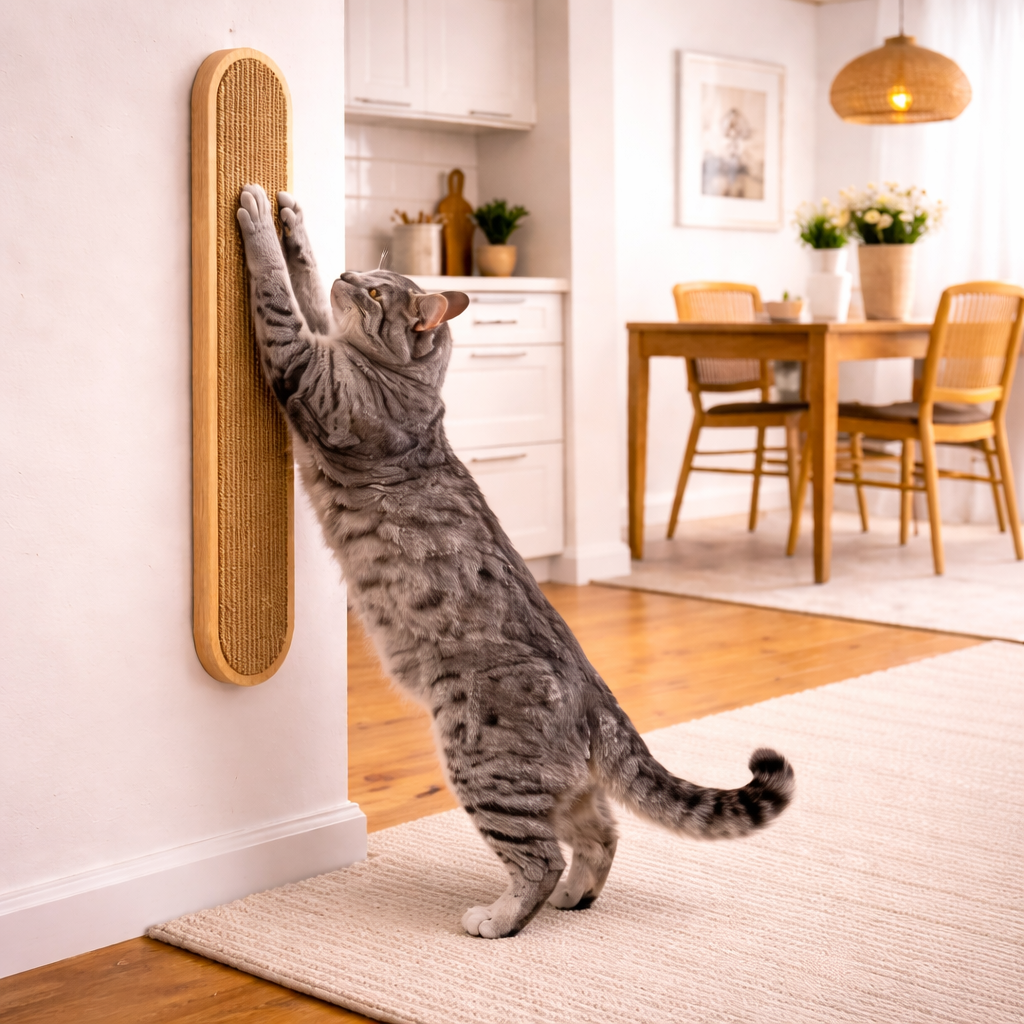
Incorrect height. Cats scratch in a full upward stretch. A post that does not allow them to fully extend is functionally useless. Most cats need a scratching surface of at least 60–70cm to stretch properly.
Wrong placement. Cats scratch in socially significant locations — near sleeping areas, near entry points, near where their humans spend time. A scratcher hidden in a utility room will be ignored. A scratcher positioned where your cat already likes to scratch will be used.
Wrong texture. Cats have preferences. Many strongly favour sisal — a natural plant fibre with satisfying resistance and texture. Carpet-covered posts often encourage the very behaviour you are trying to eliminate, because carpet feels like what is already on your floor.
The Better Approach: Wall-Mounted Cat Scratchers
Wall-mounted scratchers solve the instability problem entirely. Fixed to the wall, they provide the firm, immovable resistance that cats crave — with no wobble, no tipping, and no base taking up floor space.
At 7 Ruby Road, our wall scratchers are designed to meet cats' actual scratching needs while looking considered and intentional in your home. Because scratching furniture does not have to mean an eyesore in the corner of your living room.
The LISSE is our wall-mounted cat scratcher, hand-finished in a calm neutral palette and sized for a proper full-body feline stretch. It is simple, beautifully made, and does exactly what it needs to do. LISSE is patented in the USA.
The NERO takes things further with a replaceable sisal mat — meaning when the scratching surface wears down (as all good scratchers eventually do), you replace only the mat, not the entire unit. Less waste, lower long-term cost, and a scratcher that can last for years. NERO is also patented in the USA.
Both are made from sustainably sourced materials, wall-mounted for stability, and designed to complement a considered home interior rather than fight against it.
How to Redirect Your Cat Away From the Furniture
Once you have the right scratcher in place, the transition requires a little patience and strategy.
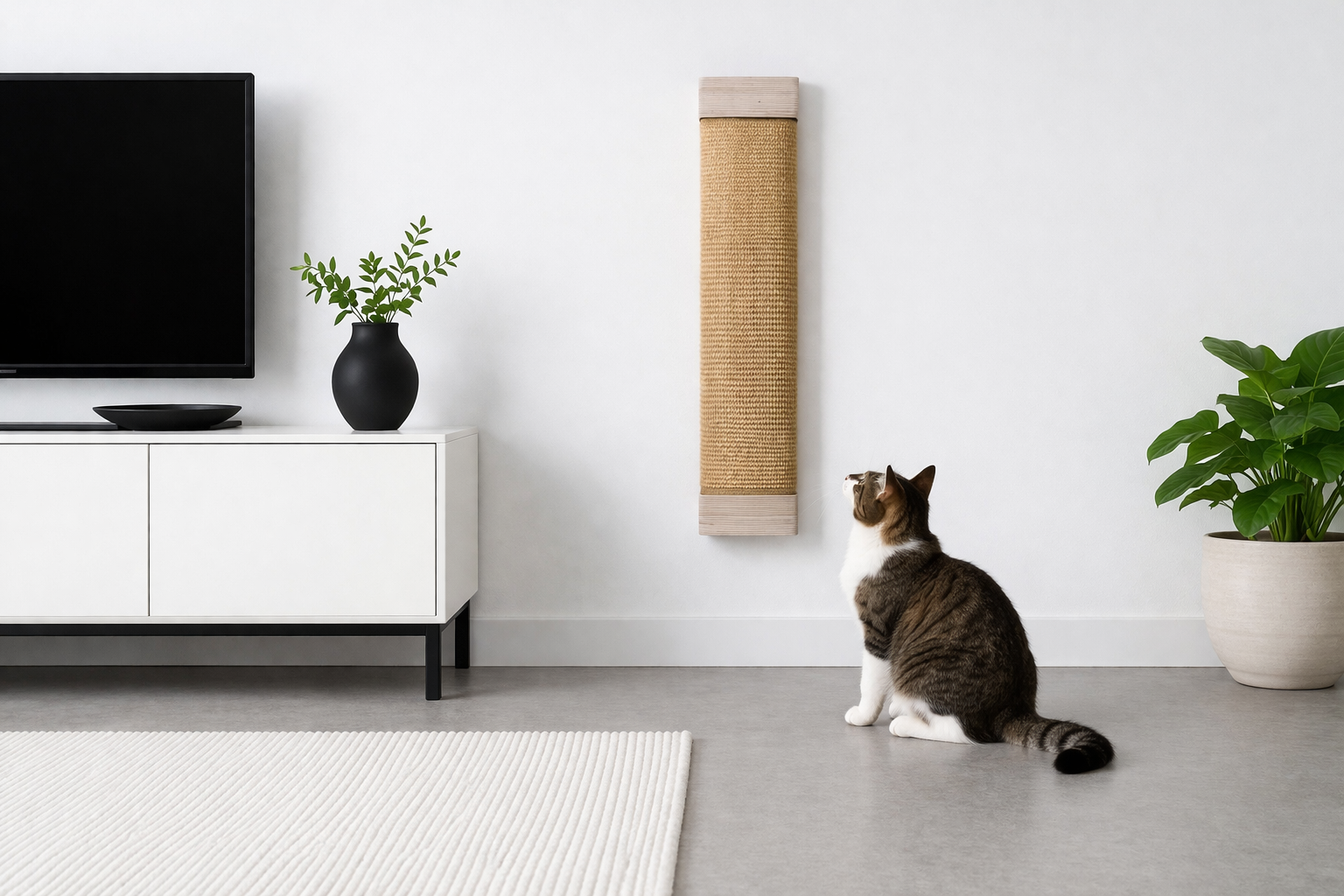
Position it well. Place your wall scratcher near the spot your cat already scratches. This is not rewarding bad behaviour — it is meeting them where they are. Over time, you can gradually shift the scratcher to a more convenient position if needed.
Introduce it actively. Do not simply install and expect results. Use a wand toy near the scratcher to draw your cat's attention. Rub a little dried catnip or silver vine into the sisal. Let them investigate on their own terms.
Temporarily deter the furniture. While your cat is learning to use their new scratcher, make the old scratching spots less appealing. Double-sided tape, furniture protector strips, or even a loosely draped blanket can interrupt the habit long enough for the new preference to establish.
Never punish scratching. Startling or scolding a cat mid-scratch achieves nothing useful. It creates anxiety — which, as noted above, increases scratching. Redirection and positive association are far more effective.
Trim their claws regularly. Not to eliminate scratching — that is neither possible nor advisable — but to reduce the damage during the transition period. A cat with freshly trimmed claws is simply working with blunter tools.
On Sustainability and Longevity
Most cat scratchers are disposable by design — compressed cardboard, cheap sisal, plastic bases. They last a few months before disintegrating and heading to landfill, at which point the cycle begins again.
NERO's replaceable sisal mat changes this equation. The wall mount stays in place indefinitely. Only the mat is replaced when worn. It is a small design decision with a meaningful environmental difference — and one that costs you less over time.
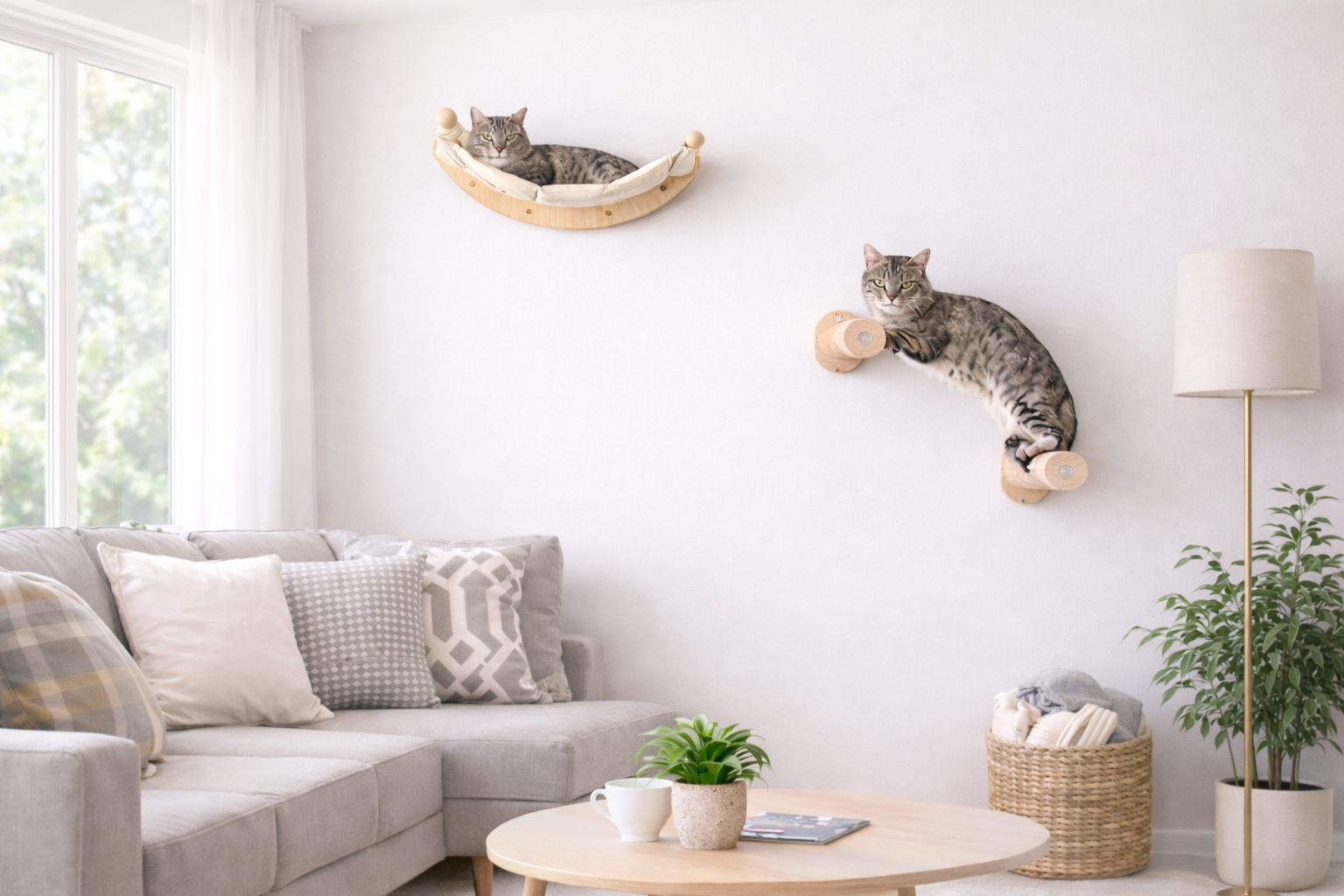
Both LISSE and NERO are part of the 7 Ruby Road wall furniture ecosystem. If you are building a more enriching environment for your cat, they pair naturally with our wall hammocks — HALTO and ALTO — to create vertical space, resting spots, and scratching opportunities across your wall. View the full collection or browse our accessories including replacement parts.
"One's furniture choices speak volumes. Fortunately, one is not the one speaking — one is the one being spoken about. Choose accordingly."
Your cat is not scratching out of spite. They are scratching because it is necessary, satisfying, and deeply instinctive. Give them something worthy of that instinct — and they will, eventually, leave the sofa alone.
Eventually.
Frequently Asked Questions
Why is my cat scratching the furniture even though they have a scratcher?
The most common reason is that the existing scratcher does not meet your cat's needs — it may be too short to allow a full stretch, too unstable to scratch against with force, or positioned somewhere your cat does not naturally spend time. Cats scratch in socially significant locations. Try moving the scratcher to where your cat already scratches, and ensure it is firmly fixed (wall-mounted options eliminate the wobble problem entirely).
What is the best cat scratcher to protect furniture?
A wall-mounted sisal scratcher offers the best combination of stability, appropriate texture, and correct height for most cats. Because it is fixed to the wall, it does not tip or slide — giving cats the firm resistance they need. 7 Ruby Road's LISSE and NERO are wall-mounted sisal scratchers designed specifically to redirect cats away from furniture while looking intentional in a considered home.
How do I get my cat to use a scratching post instead of the sofa?
Place the new scratcher next to the spot your cat currently scratches. Use catnip, silver vine, or a wand toy to encourage investigation. At the same time, make the sofa temporarily less appealing with double-sided tape or furniture guards. Reward your cat with calm praise when they engage with the scratcher. Never punish scratching — it increases anxiety and makes the behaviour worse.
Is sisal good for cat scratchers?
Yes — sisal is widely regarded as one of the best materials for cat scratchers. It is a natural plant fibre with a satisfying, rough texture that cats find genuinely appealing to scratch. It holds up well under sustained use, does not unravel like rope, and biodegrades naturally. It also does not mimic the texture of carpet or upholstery, so it is less likely to encourage scratching on those surfaces.
What is a replaceable sisal cat scratcher and why does it matter?
A replaceable sisal scratcher has a separate, interchangeable scratching pad that can be swapped out when worn — rather than replacing the entire unit. The 7 Ruby Road NERO wall scratcher uses this system. The wall-mounted frame stays in place permanently; only the sisal mat is replaced. This reduces waste, lowers the long-term cost of ownership, and means your wall installation remains intact as the scratcher is refreshed over time.
Can wall-mounted cat scratchers hold up to heavy scratching?
Yes — wall-mounted scratchers are inherently more stable than freestanding posts because they are anchored to the wall and do not move under pressure. This is precisely why cats accept them so readily. There is nothing to tip, nothing to wobble, and no base to avoid. For cats who scratch with intensity, a wall-mounted option is almost always the more effective choice.
How do I stop my cat scratching the furniture without declawing?
Declawing is a surgical procedure that removes the last bone of each toe and is widely considered harmful to cats' long-term physical and psychological wellbeing. It is unnecessary. Effective alternatives include providing appropriate scratching surfaces (ideally wall-mounted sisal), deterring furniture with tape or guards during the transition period, regular claw trimming to reduce damage, and enriching your cat's environment with climbing and perching opportunities to reduce boredom-driven scratching.

Leave a comment
This site is protected by hCaptcha and the hCaptcha Privacy Policy and Terms of Service apply.