
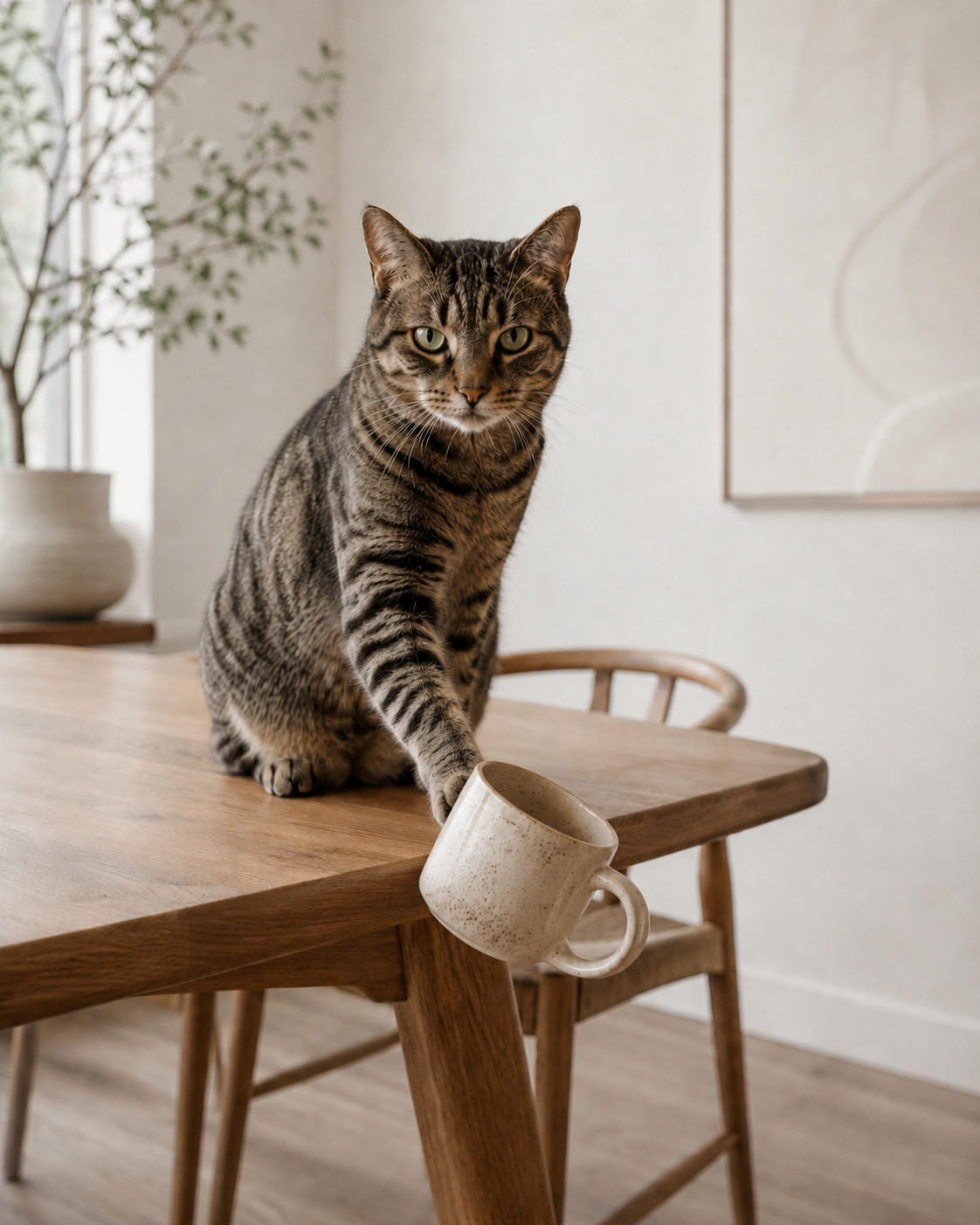
One senses the accusation before it is spoken. Yes, kitten — one nudged the glass from the table. One watched it fall. One felt nothing but quiet satisfaction. Before your human takes it personally, however, allow one to explain the science of the thing, for there is always method in one’s mischief. Usually. — Ruby
So why do cats knock things off surfaces?
It looks like pure villainy, but a cat pushing things off a table is almost always doing something quite logical from a feline point of view. Usually it’s one of these:
Attention. This is the big one. If knocking a pen off the desk once made you leap up, look over or make a noise, your cat filed that away. To a cat, even being told off is attention — and a bored cat will happily take the dramatic version over being ignored.
Hunting instinct. Cats test objects with their paws the same way they’d bat at prey. A small thing that wobbles, rolls or reacts triggers the same pawing-and-pouncing instinct they’d use on a bug. The movement is the reward.
Curiosity. Cats investigate the world with their paws. Nudging something to see what it does — does it move, roll, make a sound? — is genuine feline problem-solving, not spite.
Boredom. An under-stimulated cat invents its own entertainment, and a shelf of knockable objects is an obvious source of it. A lot of this behaviour is simply a cat with energy and nothing better to do.
Hunger or routine. Some cats learn that a bit of chaos gets them fed or gets the day started. If the knocking clusters around mealtimes, this may be the driver.
Is it attention-seeking or something else?
A quick way to read your own cat is to watch where they look. A cat that knocks something off while staring directly at you, then waits for your reaction, is almost certainly seeking attention. A cat that’s absorbed in batting an object and ignoring you entirely is following its play and hunting instincts. And a cat that only does it around feeding time is probably angling for food. The right fix depends on which one you’re dealing with.
What not to do
The single most common mistake is reacting. Jumping up, chasing, laughing, scolding — from your cat’s perspective all of it is a satisfying response, and all of it teaches the lesson “this works.” Punishment doesn’t help either: cats don’t connect it to the act, and it can add stress, which tends to make behaviour worse rather than better. The goal isn’t to punish the knocking; it’s to make it stop paying off, while giving the underlying need somewhere better to go.
How to get your cat to stop (what actually works)
A combination approach works best:
Don’t reward the reaction. Where it’s safe to, avoid responding when your cat knocks something off for attention — no drama, no eye contact. Then give plenty of attention and play when they’re not doing it, so calm behaviour is what earns your response.
Remove the temptation. Clear precious or breakable items off accessible surfaces, at least while you’re retraining the habit. Fewer targets, less reward.
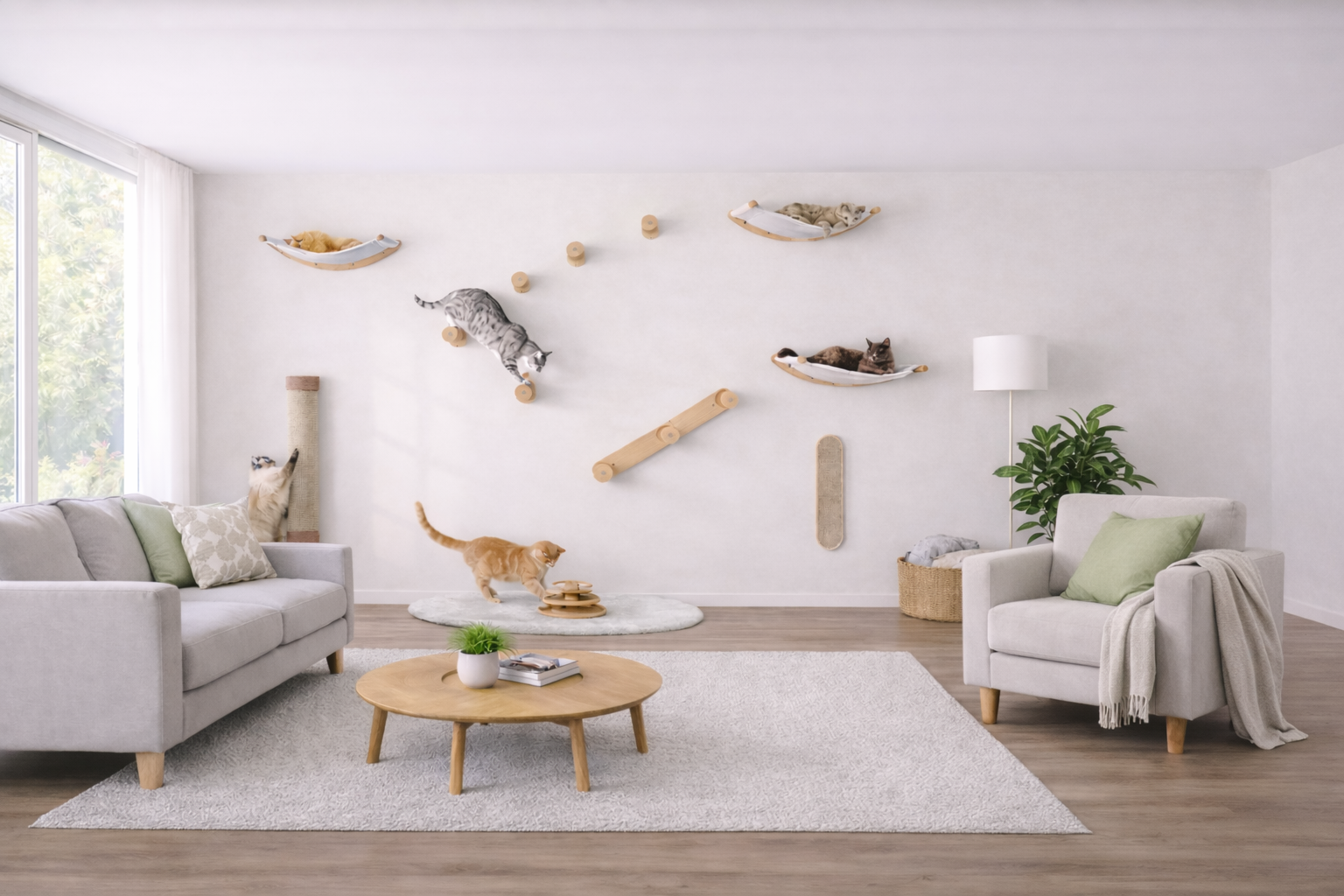
Redirect the energy. Most surface-clearing is under-stimulation in disguise, so give the instinct a proper outlet: daily interactive play with a wand toy to satisfy the hunt, a scratching surface like LISSE or NERO to work off energy, and vertical space to climb and survey. A wall perch or hammock such as HALTO or ALTO gives a bored cat a far more interesting place to be than your bookshelf.
Add foraging. Food puzzles and scatter-feeding turn mealtimes into a hunt and soak up mental energy that might otherwise go into mischief.
Be consistent. Everyone in the home has to play by the same rules — one person laughing undoes everyone else’s patience.
When knocking things off could signal something more
Usually this is a behavioural quirk, not a health issue. But a sudden increase in restlessness, or a new bout of this behaviour — especially alongside changes in appetite, litter habits, grooming or sleep — can point to stress, anxiety or an underlying medical problem. If the behaviour appears out of nowhere or comes with other changes, it’s worth a vet check to rule out anything physical before treating it as pure mischief.
A quick action plan
To curb the habit: work out whether it’s attention, play, curiosity, boredom or food driving it; stop reacting to the knocking; clear valuables off reachable surfaces; pour energy into daily play, scratching and vertical space; add foraging at mealtimes; keep everyone consistent; and see a vet if it starts suddenly or comes with other changes. Meet the underlying need and the theatrics usually fade.
So you see, kitten, one is not a vandal — one is merely under-occupied, and occasionally a scientist. Give one a wall to climb, a proper thing to hunt, and the dignity of being noticed when one is behaving, and the glassware shall live to see another day. No promises about the pen, however. Some experiments must continue. — Ruby
Frequently asked questions
Why does my cat knock things off tables and shelves?
Most often for attention, because it once got a reaction, or from hunting and play instinct, curiosity or boredom. Cats explore objects with their paws, and a wobbling item that gets a response is rewarding to them.
Is my cat knocking things over out of spite?
No. Cats don’t act out of spite. The behaviour is driven by instinct, curiosity or a learned link between knocking things off and getting your attention — not revenge.
How do I stop my cat knocking things off surfaces?
Avoid reacting when they do it, remove breakable items from reach, and redirect their energy with daily play, scratching surfaces and vertical space. Reward calm behaviour with attention, and stay consistent across the household.
Is knocking things off a sign my cat is bored?
Very often, yes. An under-stimulated cat entertains itself, and a shelf of knockable objects is easy entertainment. More play, climbing and scratching outlets usually reduce the behaviour.
Should I punish my cat for knocking things over?
No. Punishment doesn’t work — cats don’t connect it to the act, and it adds stress that can worsen behaviour. Focus instead on removing the reward and meeting the underlying need.
Could knocking things off be a sign of a health problem?
Usually it’s behavioural, but a sudden onset, or an increase alongside changes in appetite, sleep, grooming or litter habits, can indicate stress or a medical issue. If that’s the case, see a vet to rule out physical causes.


Leave a comment
This site is protected by hCaptcha and the hCaptcha Privacy Policy and Terms of Service apply.