
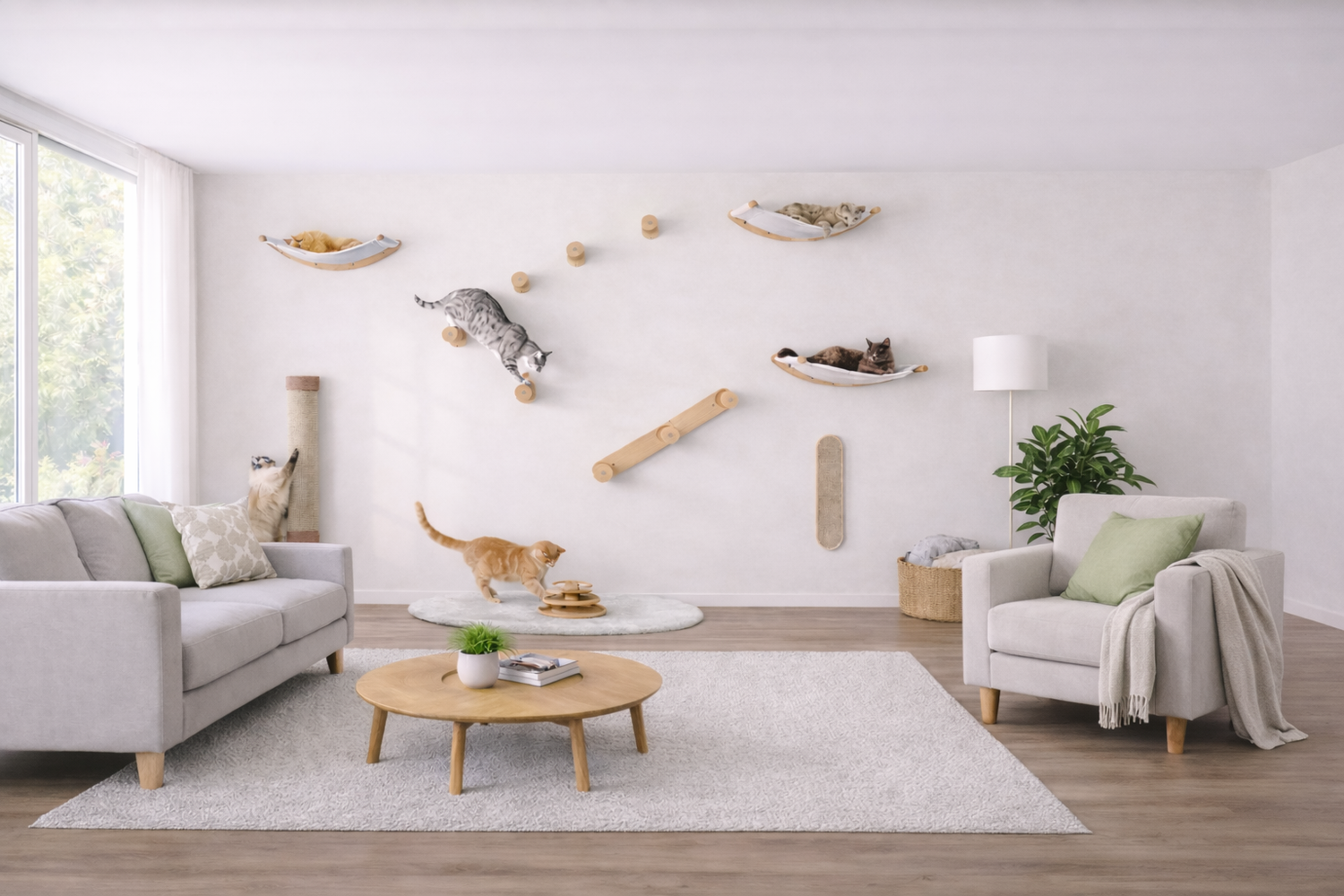
One’s human has, at last, grasped the obvious: the floor is for lesser business, and the true kingdom lies upon the wall. A cat wall, they call it. One calls it one’s rightful ascent. Before your human takes drill to plaster in a fit of enthusiasm, however, allow one to guide the endeavour — for a cat wall done poorly is an eyesore, and one does not do eyesores. — Ruby
What is a cat wall (and why your cat wants one)?
A cat wall is a set of wall-mounted pieces — shelves, steps, perches, hammocks and scratchers — arranged into a vertical route your cat can climb, explore and rest on. Instead of a single bulky tower on the floor, the enrichment lives on the wall.
Cats are hardwired to climb and survey their territory from height, so vertical space is one of the highest-impact things you can give an indoor cat. A well-planned cat wall adds usable territory without sacrificing floor space, which makes it especially valuable in apartments and smaller homes. Done thoughtfully, it reads as architecture rather than pet clutter.
Start with the wall: choosing the right spot
Before anything else, pick your wall. The best cat walls tend to share a few things:
Near a window. Cats love to watch the world and bask in the sun, so a wall beside or leading to a window instantly makes the route more appealing.
A calmer zone. Somewhere your cat already likes to spend time, away from heavy foot traffic and loud appliances.
Solid backing. You’ll need to mount into studs (or masonry), so check what’s behind the plasterboard before you commit — more on that below.
Enough clear run. Give the route a little breathing room from other furniture so your cat can jump and land safely.
Plan the layout before you drill
This is the step most people skip — and the one that separates a stylish cat wall from a chaotic one. Sketch it out first.
Mind the spacing. Steps and perches should be spaced for a comfortable step or small hop, not a leap. As a rough guide, space climbing steps around 8 to 12 inches apart vertically and stagger them left and right so your cat zig-zags upward. Adjust for your cat’s age, size and agility — kittens and seniors need gentler gaps.
Build to a destination. A route should lead somewhere worth going: a hammock, a wide perch, or a sunny lookout at the top. End on a resting spot, not mid-air.
Include a way down. Cats come down more cautiously than they go up, so make sure the descent is as easy as the climb.
Start small. You can always add pieces later. A perch, two or three steps and a hammock is plenty to begin with.
Choose your pieces
A complete cat wall usually combines a few element types. Ours are designed to mix and match into one cohesive system:
Steps for the climb. SALTO wall steps are jute-wrapped ledges that give grip for climbing and a surface to scratch on the way up.
A hammock to rest. HALTO is a single wall hammock for a sunlit nap; ALTO combines a hammock with two climbing steps as a ready-made starting point.
A scratcher to claim. A wall scratcher like LISSE or the taller NERO lets your cat stretch and mark territory as part of the route.
Keeping everything in one material family — here, solid wood with natural sisal and jute — is what makes a wall of separate pieces look intentional rather than assembled from the pet aisle.
Mount it safely — the non-negotiable part
A cat wall carries a leaping, landing animal, so mounting is not the place to cut corners.
Fix into studs or masonry. Plasterboard alone won’t reliably hold a piece taking a cat’s full launch. Use a stud finder and mount into the timber, or use appropriate fixings for brick and concrete. Some pieces, such as our SALTO steps, are designed for stud or masonry fixing rather than plasterboard.
Use the right fixings. Follow each product’s instructions and use the specified screws and anchors for your wall type.
Test before you trust it. Once mounted, apply firm downward pressure to check each piece is solid before letting your cat use it.
Check it periodically. Give fixings an occasional re-tighten, especially in the first few weeks.
If you’re unsure about your wall type or fixings, it’s worth having a handyperson mount the load-bearing pieces.
Style it so it enhances your interior
The whole point is enrichment that doesn’t cost you your aesthetic. To keep it looking designed: choose pieces in natural materials and neutral tones that match your existing decor; align them with other lines in the room, like shelves or window frames; leave breathing room around the arrangement rather than crowding the wall; and keep surfaces clean — a washable replacement cushion keeps a hammock looking fresh for years. Grouped well, a cat wall becomes a feature, not an apology. Browse the full collection to build a coordinated set.
A quick cat-wall setup checklist
Before you drill: choose a wall near a window with solid backing; sketch your layout with comfortable spacing and a clear destination; pick pieces from one material family; confirm your fixings suit your wall type; mount into studs or masonry and test each piece; and include a scratcher and a resting spot so the wall meets more than one instinct. Get those right and you’ll have a cat wall that works for your cat and your home.
And there one shall reign, kitten — surveying one’s domain from a height befitting one’s station, while one’s human admires their handiwork from the floor below. A cat wall, built with care, pleases everyone: the cat receives a kingdom, and the human keeps their tasteful little room. One does so enjoy an arrangement in which one wins. — Ruby
Frequently asked questions
What is a cat wall?
A cat wall is a set of wall-mounted pieces — steps, perches, hammocks and scratchers — arranged into a vertical climbing and resting route for your cat. It adds enrichment and territory without taking up floor space.
How do I set up a cat wall?
Choose a wall near a window with solid backing, sketch a layout with comfortably spaced steps leading to a resting spot, pick coordinating pieces, then mount everything securely into studs or masonry and test each piece before your cat uses it.
How far apart should cat wall steps be?
As a rough guide, space steps around 8 to 12 inches apart vertically and stagger them side to side so your cat can zig-zag upward comfortably. Use smaller gaps for kittens, seniors or less agile cats.
Do cat walls need to be fixed into studs?
Yes, for anything that bears your cat’s weight. Plasterboard alone won’t reliably hold a climbing or leaping cat, so mount into wall studs or use proper masonry fixings, and follow each product’s instructions.
Are cat walls good for small apartments?
Very. Because a cat wall uses vertical space instead of floor space, it’s one of the best enrichment options for small apartments, keeping rooms open while still giving your cat somewhere to climb and perch.
Can a cat wall actually look good in my home?
Yes. Choose pieces in natural materials and neutral tones, align them with existing lines in the room, and leave some breathing space. Done well, a cat wall reads as an intentional feature rather than pet clutter.

Leave a comment
This site is protected by hCaptcha and the hCaptcha Privacy Policy and Terms of Service apply.